

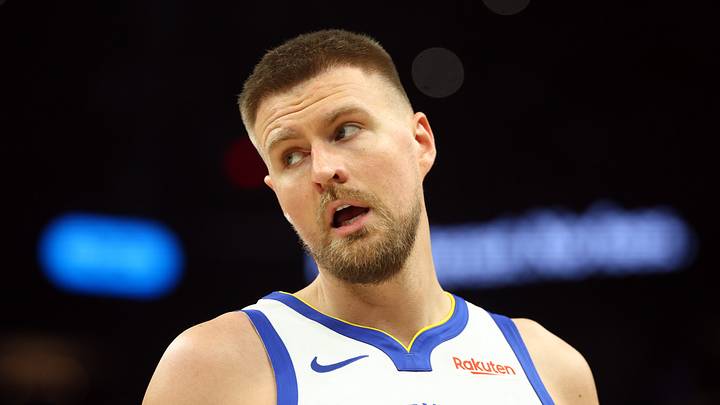
Apart from their flurry of partially-guaranteed and Exhibit-10 deals late in this offseason, the Golden State Warriors have mostly been content running it back.
They re-signed Kristaps Porzingis, Al Horford, De'Anthony Melton, Gary Payton II, Draymond Green, and even Charles Bassey this season. Without much flexibility on the open market, there wasn't room for them to do much else. But of course, the question persists—
Is doing the same thing and expecting a different result not the definition of insanity?
For the Warriors, it might not be. If everything unfolds in their favor—including the returns of Jimmy Butler and Moses Moody from their respective season-ending injuries—there's certainly room for this team to enter the Play-In Tournament with some wind under their sails. If they struggle with injuries again, though, there's room for this team to be among the least threatening in the Western Conference.
Much of this will come down to the success of Golden State's offseason re-signings, so let's take a look at what the potential best and worst case scenarios for each of these pieces might be in 2026-27.
Floor and ceiling evaluations for each of the Warriors' offseason re-signings
Draymond Green, PF
Best Case: We saw Green's offensive efficiency take a hit in virtually every measurable category in 2025-26. This was especially concerning as Golden State's offense struggled to find consistency in the absences of Butler and Curry. If Green is able to take a step back in terms of his shot volume while finding some more reliable footing on the interior and the perimeter, it would go a long way toward helping him hang onto a starting spot over the duration of the season. Perhaps we see him gain back a step on the defensive end of the floor as well.
Worst Case: The worst-case scenario for Green is becoming completely disposable to this Warriors rotation, which could very well happen if his offensive struggles continue and Butler and Yaxel Lendeborg solidify themselves as Golden State's starting frontcourt pairing. If Green shoots close to 40% from the field again, his one-year, $28 million deal could look much more attractive as a potential trade chip for the Warriors.
Kristaps Porzingis, C
Best Case: Porzingis plays in upward of 65 games and, on the shoulders of an excellent perimeter shooting campaign, averages above 20 points per game with a real shot at the All-Star Team after the first half of the season. He operates as a true rim-protecting and floor-spacing force next to Curry in the starting lineup, and he's able to help keep this team afloat as their second option until the rotation becomes whole again.
Worst Case: Porzingis has played in just 131 games over the past three season, so the floor here is pretty easily visible. If he's not able to consistently remain on the court, Golden State will be forced to turn to a combination of Al Horford and Charles Bassey to get the job done at the center spot. The worst-case scenario here is simply that Porzingis can't play nearly as much as the Warriors are banking on in 2026-27.
Al Horford, C
Best Case: Horford's best-case scenario is linked to Porzingis'—primarily because Horford is best suited as a bench center and a complementary floor-spacing threat at this point in his career. If he can provide the Warriors with solid minutes, swinging between the bench and the starting lineup when necessary, and can play over 65 games over the course of the season, he'll be exactly what Golden State bargained for when they first added him ahead of their last campaign.
Worst Case: It's important to acknowledge, though, that Horford's offensive stats also took a dip in 2025-26. He knocked down just 36.1% of his attempts from beyond the arc, and at age 40, he can't truly afford for that number to get any lower. If his offensive efficiency continues to drop, the Warriors could be left with a major hole on their bench unit.
De'Anthony Melton, SG
Best Case: Melton signed with the Warriors last season on a veteran minimum deal in hopes of returning from his torn ACL and earning a major pay raise this offseason. That didn't quite happen, but Melton did get a bump from Golden State on his new two-year deal with a player option. If he can shoot it more consistently from beyond the arc and wrestle a starting backcourt spot away from Brandin Podziemski, he could be looking at a much different landscape this time next year.
Worst Case: Melton's two biggest concerns at this point are his health and his perimeter shooting. We saw both take a hit late last season as he dealt with fatigue and an accruement of various ailments. If Melton can't up his effectiveness on the offensive end of the court and he's limited to somewhere around 40 or 50 games, Golden State's rotation will suffer heavily for it.
Gary Payton II, PG
Best Case: Payton is an interesting one. On the surface, he's simply been brought back as a trusted, veteran member of the rotation. We know what to expect from him, and the gap between his ceiling and his floor might be the narrowest of any player on this list. But if he's able to still play a major role for Golden State with his hustle-oriented approach to his minutes, he might be able to justify his return over a younger piece with higher upside.
Worst Case: Payton's worst-case scenario is simply the converse of the above section. If he becomes even more unreliable on the offensive end and is surpassed by either LJ Cryer or one of the Warriors' other potentially rostered guards for a rotational role, you can expect Payton's time in Golden State to be coming to a tentative end.
Charles Bassey, C
Best Case: We only saw Bassey play five regular season games with the Warriors in 2025-26, but they were certainly exciting. With Quinten Post gone in restricted free agency, Golden State will be counting on Bassey to provide high-energy, rebounding minutes in complement to Porzingis and Horford. If Horford or Porzingis goes down at any point this season, though, Bassey will suddenly have the opportunity to prove himself as a true, rotational option at the big man position. For a player trying to finally earn a steady role in the NBA, that's an opportunity that needs to be seized.
Worst Case: As much excitement as Bassey provided last season, there's also some room for doubt in terms of his viability with more extensive minutes on his hands. Is he truly a positive defender, and will his lack of shooting away from the basket limit the Warriors' offensive flow? This is truly only a potential problem if Bassey is trusted with major minutes at any point this season, but it's a set of flaws that could quickly become apparent under the right circumstances.
 Add us as a preferred source on Google