

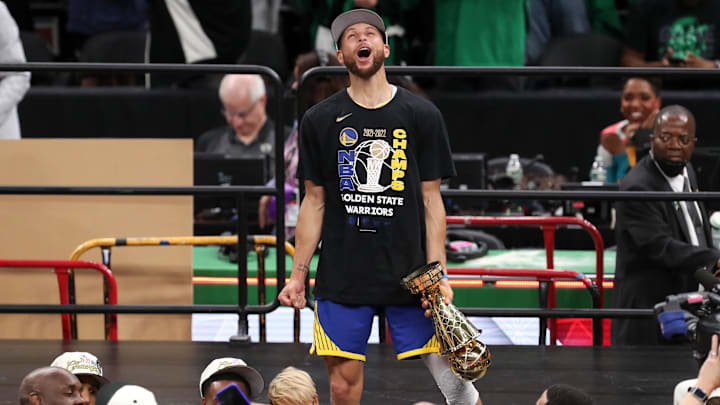
“Too skinny,” “can’t get to the rim at the NBA level,” “can’t be relied on to run an NBA team,” and “poor shot selection”: those were some of the evaluations outlined in Stephen Curry’s 2009 pre-draft scouting report. Little did those “experts” know that the undersized point guard out of Davidson would establish himself as the greatest shooter of all time and one of the most decorated players in NBA history.
Despite being the son of a former NBA player, basketball was not always the most obvious path for Stephen Curry. Dell Curry, his father and one of the NBA’s most prolific shooters, played 16 seasons in the league and was also selected by the Baltimore Orioles in the 1985 MLB Draft. After a brief period of uncertainty in seventh grade, Stephen Curry—who has repeatedly stated that his father never pressured him either way—ultimately committed to basketball.
Stephen Curry's rise has been nothing short of remarkable
Coming out of high school at 6 feet tall, Curry was not regarded as a highly touted recruit. His shooting ability and basketball IQ proved insufficient to counterbalance his modest physical stature, and he did not receive scholarship offers from major college basketball programs.
Davidson College, a small institution in North Carolina, was willing to invest in his potential. Curry entered the 2009 NBA Draft after three accomplished seasons there. His collegiate tenure was highlighted by an against-the-odds Elite Eight run in 2008, during which the world first caught a glimpse of what would later become his trademark: the three-point shot.
Curry’s NBA career began on a promising note. He appeared in 80 of a possible 82 games and averaged 17.5 points, 5.9 assists and 4.5 rebounds during his rookie season with the Golden State Warriors. However, a left ankle sprain in March 2010 would later prove to be an early sign of the injury troubles that followed.
During his sophomore season, the number of games he missed increased slightly. As ankle issues persisted and surgery followed, the accumulation of injuries took its toll, forcing him to miss 56 games in 2011–12. A month after receiving medical clearance to return, he signed a four-year, $44 million extension with the Warriors in October 2012. From the outset, the deal was widely viewed as a likely bargain.
After two injury-free seasons, Curry’s breakout finally arrived. During the 2014–15 campaign, he knocked down a then-record 286 three-pointers and helped the Warriors win their first NBA championship in 40 years.
Those achievements earned him recognition from his peers, who voted him the league’s Most Valuable Player. At a time when many believed Curry had reached his ceiling, he achieved something unprecedented.
First, he shattered his own single-season record of 286 made three-pointers by making 402. Second, he led the Warriors to a historic 73–9 record, surpassing the Chicago Bulls’ 1995–96 mark by one win. Finally, Curry became the first player to win the MVP award unanimously, a distinction that remains unique in NBA history.
Stephen Curry went on to deliver three additional NBA championships to the Bay Area and remains in pursuit of a fifth. More importantly, his influence extends beyond titles and accolades. If Michael Jordan helped globalize the NBA and LeBron James redefined longevity, Stephen Curry transformed the way modern basketball is played.
 Add us as a preferred source on Google