

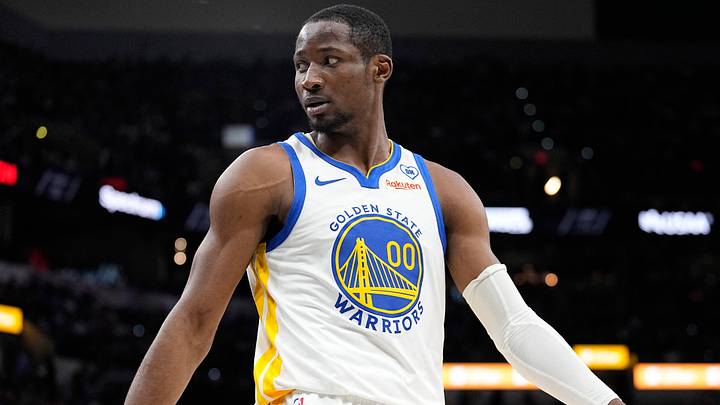
We've now reached the end of this offseason's Jonathan Kuminga saga— the second in as many years. At least this time it didn't involve the Golden State Warriors.
With offers on the table from the Los Angeles Lakers, the Chicago Bulls, and the Portland Trail Blazers, Kuminga chose to sign a two-year, $13 million deal with the Minnesota Timberwolves. It will include a player option, which will allow him to opt out next offseason and seek a larger deal on the open market.
The Warriors are familiar with this gameplan from Kuminga's representation. They offered him a three-year, $75 million extension before he hit restricted free agency, which he ultimately turned down to negotiate a two-year, $46.8 million deal with a team option. That resulted in his trade to the Atlanta Hawks, who chose to decline that option.
With three years, $36 million, and a near-guaranteed starting role on the table with Los Angeles this offseason, Kuminga instead chose to bet on himself. But at the end of the day, how much more can he truly maximize his value?
It's an issue that Golden State knows well, and it's the reason his time with the organization came to an end.
Jonathan Kuminga will almost certainly outplay his contract in Minnesota— but where does that leave him next offseason?
Let's start by acknowledging the upside on this move for Minnesota. Kuminga, at the very least, is a capable scorer and downhill slasher, and adding him to the frontcourt in a roster already graced with plenty of spacing and dynamic ball movement could be a recipe for success.
Of course, Kuminga might not get the on-ball reps he craves. Both Anthony Edwards and LaMelo Ball are high-usage players. But even if he averages, say, 15 points on a game on close to 47 or 48% shooting from the field, that sort of production is worth much more than $6.5 million a year.
Kuminga has now turned down a long-term extension twice in favor of flexibility. One would assume, then, that he thinks he can earn significantly more than the $12 million annually Los Angeles offered.
If we're projecting a complementary role for Kuminga, though, his ceiling next offseason would likely lie somewhere around the full non-taxpayer mid level exception— which is projected to sit at $15.8 million in 2027-28, per Spotrac.
Theoretically, Kuminga could be worth more than that. He has the athleticism and the scoring upside to be a primary option for any number of non-contending teams. But his lack of consistent rebounding and defense and his dependency on isolation play have been what's limited him to this point in his career. Minnesota doesn't give him a blank slate in that regard— but they do give him a fresh opportunity to prove himself as a complementary piece in a winning system.
At best, Kuminga is likely looking at an extra $3.8 million over what he could've had in Los Angeles. He's bet on himself again this offseason, and the Warriors are certainly familiar with how this storyline plays out..
 Add us as a preferred source on Google