

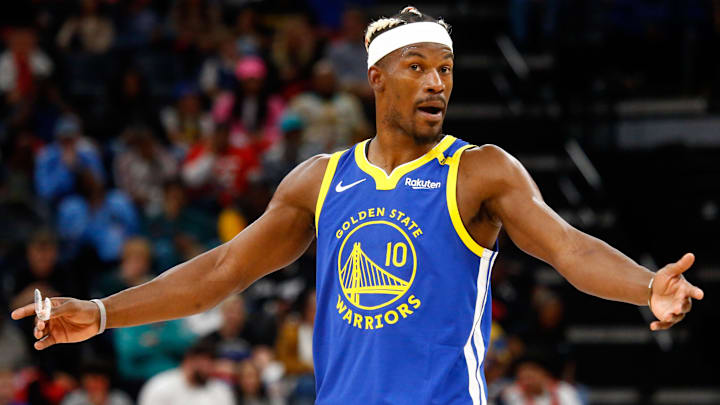
The Golden State Warriors’ 114–113 nail-biting win over the Memphis Grizzlies on Monday night marked their 10th game since Jimmy Butler went down with an ACL injury on Jan. 19 against the Miami Heat.
Unsurprisingly, both the offense and defense have been impacted — but not to the same degree as the Warriors try to keep their head above water and adjust to their new reality without the 6x All-Star.
The Warriors long believed Jonathan Kuminga would be a key piece of the core moving forward, and that he could help fill Butler’s shoes in his absence. But internal complications made that impossible, and he was eventually traded to the Atlanta Hawks.
Fortunately, unlikely contributors have stepped up.
Warriors offense has plummeted without Jimmy Butler
The Warriors weren’t an elite offensive team even with Jimmy Butler. The primary reason is simple: Golden State relies heavily on the three. With or without Butler, they attempted — and made — threes at a top-of-the-league rate. The issue is that it too often becomes their entire offense. The Warriors don’t consistently generate points in the paint or in transition, and those areas haven’t materially changed since Butler went down.
What has changed is the efficiency: their offensive rating has dropped from 115.7 (12th) to 108.3 (29th), and they’re scoring about six fewer points per game. The biggest factors are ball security and a reduced ability to get to the free-throw line — something Butler consistently provided.
Despite the numbers not being mind-blowing, they’re still relevant. The Warriors have attempted the fifth-fewest free throws in the league during that stretch (19 per game), highlighted by a two-free-throw outing against the Philadelphia 76ers.
Butler, a master in this art, was averaging 7.6 trips to the line per game while hitting 86.4% of them. He accounted for roughly a third of Golden State’s free-throw volume, so yes, a void has been left unfilled.
Since his injury, nobody aside from Stephen Curry (who has missed the last four games) has averaged more than three attempts per game, with De’Anthony Melton sitting right at that number.
Beyond the numbers, losing the second offensive threat Butler was has weighed on Curry and the entire offense. His ability to hunt mismatches, punish doubles with quick reads, and put pressure on the rim — generating trips to the charity stripe in the process — isn’t something this roster can replicate right now.
Golden State also lost a ball-handler in Butler, and the auditions to take over haven’t inspired confidence. The Warriors are averaging 1.5 more turnovers per game, and the players handed additional playmaking duties have struggled to take care of the ball.
Brandin Podziemski has gone from 1.4 to 2.1 turnovers per game, Melton has jumped from 1.3 to 2.6, and Draymond Green has had several three-turnover games — and committed seven in Sunday’s win over Memphis.
Defense has kept the Warriors afloat
The defensive rating has stayed steady (112.2), but while it was an elite mark over the 38 games Butler played, it’s been closer to league-average in the 10 he’s missed.
Opponents are shooting more efficiently from the field (+2%), hitting more threes (up 1.4 per game) and knocking them down at a much higher clip (+5%).
Still, Golden State’s on-ball grittiness is the main reason the defense hasn’t fallen apart the way the offense has. Over that 10-game stretch, the Warriors have forced the most turnovers per game in the NBA (18.8), turning those miscues into just over 20 points per night.
With the offense scoring around 110 points per game in that span, that’s roughly one-fifth of their production coming directly off turnovers.
Despite maintaining a certain steadiness overall, the defense has still suffered multiple breadowns. This season, the Warriors have allowed 38+ points in a quarter 13 times — with six of them occurring in the last 10 games: 38 three times, 39, 41 and 45.
Unexpected heroes help steady the ship
The injury left a lot of minutes up for grabs, and multiple players have gladly seized them. Three names spring to mind: Moses Moody, Pat Spencer and Gui Santos.
Moody has provided a welcome scoring boost, going from 10.7 points per game to 14.6, highlighted by a 25-point eruption against the Utah Jazz while leading the Warriors with 30 made threes over that span.
The other two have gone from bench fillers to rotation mainstays. After initially sticking to his usual role — and still on his two-way deal — Spencer proved his value against the Philadelphia 76ers on February 3 and hasn’t slowed down since. He’s averaged 16 points, 4.5 rebounds, 5.3 assists and 1.3 steals over his last four games, earning a standard NBA contract in the process.
If we had to name one player who’s come closest to “replacing”Jimmy Butler, it would be Santos: his defensive sturdiness, sharp cutting, quick decision-making, and overall scrappiness mirror the type of impact Butler provided better than anyone else on the roster.
While the emergence of those players is a major positive, the Warriors still need more scoring.
With both Curry and Porzingis expected to return after the All-Star break, it’ll be interesting to see how Steve Kerr handles his rotation.
He’s already floated the idea of sticking with Santos once everyone is healthy. A lineup of Curry–Moody–Santos–Green–Porzingis feels like a no-brainer.
What happens to Pat Spencer's minutes? Does Kerr trim Brandin Podziemski’s workload? We’ll have to wait until after the All-Star break to find out.
 Add us as a preferred source on Google