

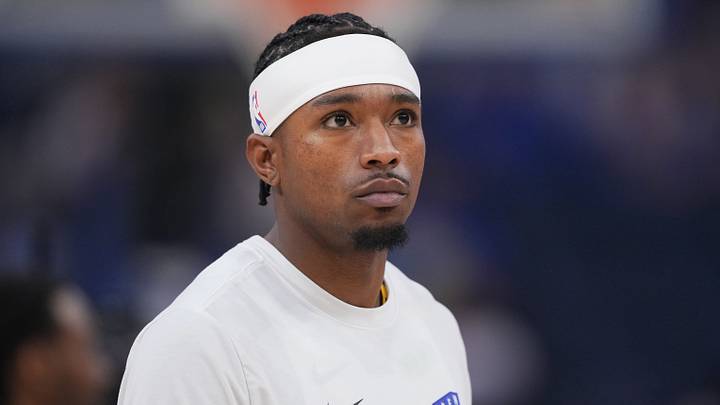
Losing Steph Curry a few minutes into their road trip opener in Houston sapped the Warriors' offense of the rhythm it had built over the previous two weeks. Having lost his backup – Brandon Williams – a couple of nights earlier exacerbated the issue. In the span of 48 hours, Golden State was stripped of Curry's game-changing gravity and Williams' chaos-inducing quickness.
Out since November 9 with a left hamstring strain – a delicate injury for players with Williams' explosiveness – Williams went through a light scrimmage against coaches on Tuesday and is expected to return against the Sacramento Kings on Wednesday night. Getting Williams back will add a much-needed layer to a rudderless offense.
A shifty guard capable of creating for himself and others, Williams provides Steve Kerr a reliable option to counter ball pressure. He will also ease the burden on Brandin Podziemski and Yaxel Lendeborg by initiating some of the offense, something Podziemski and Lendeborg have had a hard time doing with both Curry and Williams – the only two true point guards on this roster – on the shelf.
As the Warriors extended their winning streak to eight games with a blowout win over the Pelicans, Williams was forced to exit the game after just 1:39 of action. The injury occurred on his first play of the game. He tried to test his hamstring out on defense on the next possession but realized something wasn't right when he attempted to make a familiar move – a low pickup – the next time he had the ball and felt the pain a second time. Williams ended up missing six straight games and had to endure watching his team play from the sidelines.
"I ain't gonna lie, that sh-- been tough watching that," Williams said of the Warriors' offense over the last six games.
Golden State has played five complete games without either Curry or Williams. Over those five games, it's averaged 91.8 points per game on 38% shooting from the field and 27.1% from three-point range, and turned the ball over 18.2 times per game for just 23.8 assists. Through their first 11 games, the Warriors were averaging 120.4 points per game while shooting 47.7% from the field and 40.3% from three before Curry joined Williams on the injury report.
The glaring lack of a reliable table-setter thrust several players into unaccustomed roles. Gui Santos' usage rate went from 14.1% before the Williams/Curry injuries to 21.5% since. Lendeborg's usage barely changed (from 26.3% to 27.7%), but his efficiency cratered. The rookie went from averaging 21.4 points on 13.7 field-goal attempts to 13.4 points on 15.6 field-goal attempts. Podziemski's efficiency also dropped off while he averaged two fewer assists per game as his usage rate increased by almost three percentage points. In other words, an offense made up of players tasked with unfamiliar responsibilities looked understandably helpless.
"I know exactly what I need to do," Williams said. "Just watching from afar, not being in the game you see a little bit more. The offense gets stagnant at times and I know it's what they brought me here for, to keep it rolling, keep it going, keep everybody organized and stuff."
How Brandon Williams can get the Warriors’ offense moving again
A stagnant offense leads to plenty of late-clock attempts due to a lack of organization, a lot of out-of-rhythm shots due to a lack of creativity, and a lot of turnovers caused by ball pressure. Williams' blazing speed and rim-attacking mindset offer a viable solution to those issues.
Defenders can't ball-pressure Williams the same way they would Podziemski or Lendeborg. Williams' twitchiness makes him elusive. Despite his limited playing time across his 10 games with the Warriors this season – 16.1 minutes per game – Williams' 10 drives per game rank third on the team, behind only Lendeborg (13.8 in 31.7 minutes) and Curry (10.4 in 26.5 minutes). Williams is also a threat when penetrating into the paint. His 5.2 paint points per game are the fourth-most on the team, behind only Lendeborg (8.7), Charles Bassey (6.9), and Curry (5.6).
When Williams drives to the basket – which, as the numbers show, he does a lot – defenses have to make a decision: send a defender to help or let him get to the rim. Automatically, putting the ball in Williams' hands will generate some kind of offense. It should allow Podziemski to return to a more complementary role in which he thrived to open the season. It should open up driving lanes for Lendeborg. And it should create more open looks on the perimeter. It gives the Warriors a way to gain an early advantage and capitalize on it.
As Curry's backup, Williams is no stranger to playing without the Chef, as the duo hasn't spent a single minute on the floor together this season. Besides, Williams has spent most of his minutes with the second unit alongside Podziemski and Lendeborg, and the trio has produced some gaudy numbers. Consider the small sample size – 70 minutes – but the Williams-Podziemski-Lendeborg three-man lineup has posted an eye-popping +33.2 net rating. In Williams' 161 minutes this season, the Warriors have posted a +11.7 net rating.
The numbers look encouraging on paper, but Williams alone won't bring back the kind of dynamic this team played with when he first got injured. He can, however, make defenses think. That alone could go a long way for an offense that has now failed to score 100 points in five consecutive contests. The last time the Warriors fell short of the 100-point mark in six straight games was in 2012 – Curry didn't appear in any of those six games either.
Playing the Kings – one of the worst defenses and offenses in the NBA – while getting Williams back seems to be the perfect opportunity to snap that dubious streak.
 Add us as a preferred source on Google