

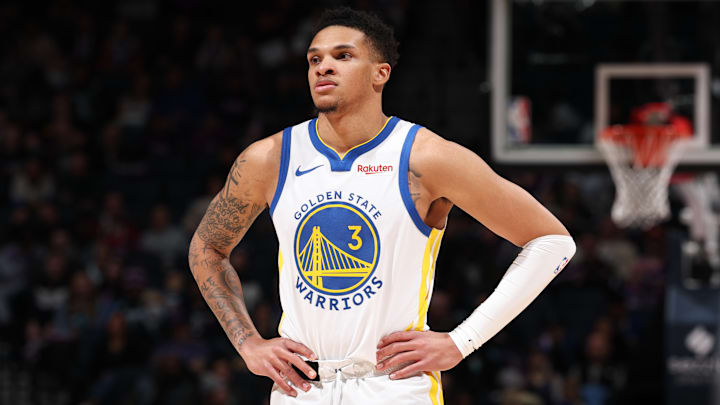
The Golden State Warriors opened a four-game road trip last Thursday in Dallas, and overall, things have looked bleak. Despite a statement win on the front end of the back-to-back in Minnesota, the trip has exposed a lack of consistent scoring, playmaking, and shooting — though a growing defensive edge has helped offset those deficiencies.
A bright spot has emerged from those recent dark times: defensive intensity. Golden State has ramped up its scrappiness on that end of the floor, largely to offset its offensive shortcomings, and it should continue leaning on that identity going forward.
Warriors must cling onto their defensive identity
It’s been a collective effort, as five players are averaging at least two steals during that stretch, contributing to the Warriors recording the most steals in the league over that span (48). Even Jonathan Kuminga, who exited midway through the second quarter with a leg injury last Thursday in Dallas, came away with two takeaways in his nine minutes of action.
Rookie Will Richard has been leading the charge, averaging four steals per game, fueled by a six-steal outing Monday night in Minnesota. The former Gator leads the NBA in steals per game (four) and total steals (12) over that three-game span.
The next step for the rookie is finding an offensive rhythm, an area where he has been inconsistent. Over that same stretch, Richard averaged just 4.7 points, 1.3 rebounds and 2.0 assists while shooting 31.6 percent from the field and 16.7 percent from three in 21.7 minutes per game.
Still, he’s shown flashes in the past, highlighted by a 20-point performance against Phoenix on Dec. 20 and a 30-point outing in Sacramento on Nov. 5, when most of the starters were in street clothes.
Turnovers prove another encouraging development
Another silver lining to grow out of the chaos is Golden State’s improved ball security and defensive disruption. Even after committing 18 turnovers in a lackluster, uninspiring 108–83 rout in Minnesota, the Warriors still rank 13th in the NBA in turnovers per game (13.7) over this road trip.
Moreover, the ball pressure has raised some eyebrows. The Warriors forced 21, 25, and 22 turnovers in their three road games, leading the league with an average of 23.3 per game. That ramp-up in intensity -- and the ability to create havoc -- has allowed an offensively limited Warriors team to get 40 more shots up than their opponents over those three games.
The issue is that they haven’t been able to capitalize on those extra opportunities, shooting just 40.6 percent from the field (28th) and 29.4 percent from distance (25th). Getting Jonathan Kuminga back --- who’s been ruled out for Wednesday’s game in Utah -- should certainly help address that moving forward.
The numbers hinted at his impact during the limited minutes he logged before exiting midway through the second quarter in Dallas. In the 31 minutes Kuminga was on the floor, the Warriors posted a team-best 135.7 offensive rating and a 104.2 defensive rating, resulting in a +31.5 net rating. Conversely, with Kuminga off the floor, the offensive rating tumbled to 96.3 (second-worst) while the defensive rating ballooned to 109.6.
If Kuminga is able to return Friday against the Hawks -- assuming he isn’t moved for Andrew Wiggins or another player in the meantime -- it’ll be interesting to see the impact the fifth-year forward can have over an extended stretch.
The Warriors will look to apply that game plan against a Jazz team that shapes up as the perfect prey. Utah ranks 29th in opponent points off turnovers per game (20.9), 27th in turnovers per game (15.7), and forces just the fifth-fewest miscues per contest (13.4).
Despite Utah averaging 118.7 points per game, Golden State should come away with a win -- and fly back to San Francisco with a 2–2 record on this dreaded road trip -- if it capitalizes on those weaknesses.
 Add us as a preferred source on Google