

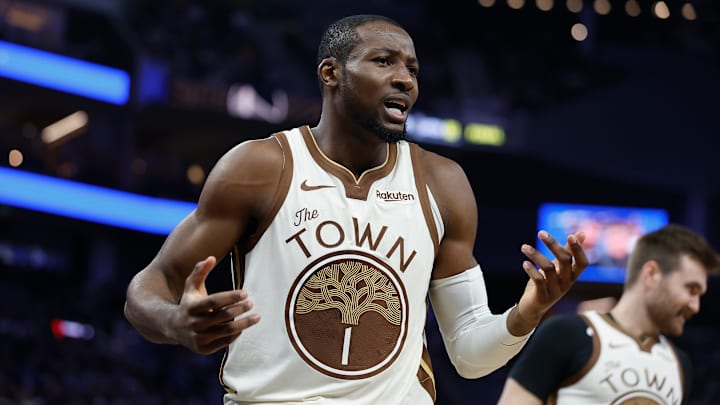
The single worst-kept secret in the NBA is that the Golden Sate Warriors intend to trade Jonathan Kuminga. An agonizing period of restricted free agency failed to yield the sign-and-trade Kuminga was hoping for and Golden State hasn't exactly responded by rewarding his return with playing time.
With a recent string of absences from the rotation that reflect the events that caused the strain between player and organization in 2024-25, trading Kuminga is the only option left.
The unfortunate truth facing Golden State is that Kuminga's market value is an absolute uncertainty. Many covet his talent as a 23-year-old scorer who can get inside and finish at multiple levels, rebound at a high level for his position, and even create for others with a respectable level of proficiency.
Leverage was lost a long time ago, however, and the Warriors may now struggle to find the return they once dreamed of for their embattled scoring threat—a harrowing possibility that's not exclusively due to their own mistakes.
According to Tim Bontemps of ESPN, an anonymous NBA executive believes the 2026 trade deadline will be relatively uneventful and that many players will be "stuck where they are."
"All these guys are going to be stuck where they are," the first West executive said of the lead-up to the Feb. 5 trade deadline. "I don't think it will be as busy as people think, and I don't think the available players will be that good."
Kuminga has a tradable salary at two years and $46.8 million with a second-year club option. Perhaps that will save the Warriors in the end, as a rival executive can take a chance on the former top-10 pick without risking too much in the long run.
If the Warriors are hoping to avoid an unmitigated disaster, however, then they'll need to either trade Kuminga on Jan. 15 or play him to improve his market value.
Warriors must either play Jonathan Kuminga or trade him on Jan. 15
Kuminga will become eligible to be traded on Jan. 15. Thankfully, that date isn't all that far away. If the Warriors are hoping to maximize their return for him, then it would be wise to move him on that date rather than tempting fate closer to the Feb. 5 trade deadline.
While most teams are still internally debating what the ideal next move would be, the Warriors are in a somewhat advantageous position of being able to act with a sense of certainty about their next step.
Delaying the inevitable would do them no favors, as the market will be flooded with available talent the closer the calendar gets to Feb. 5. In that scenario, the Warriors won't just be trying to sell rival executives on Kuminga as an ideal piece of their puzzle.
Instead, Golden State will be left hoping that, as a team with no reasonable leverage whatsoever, someone covets Kuminga enough to overlook the possibility of a decline via inactivity.
The alternative, of course, would be to play Kuminga more frequently ahead of the Feb. 5 trade deadline. In that scenario, he could make a positive impression on executives who may be skeptical of giving up assets for a player who can't even crack Steve Kerr's rotation.
Optimism states that the NBA already knows what they'd be getting from a trade with Kuminga, but that hasn't yet proven to be the case considering how the summer events transpired.
Perhaps the Warriors' polarizing approach won't be quite as harmful as it appears to be in the end and all concern is misplaced. One simply can't help but wonder why a team would give the Warriors significant assets in a trade for a player who has effectively spent the past two years treading water.
As such, with mere days remaining until he's eligible to be traded, the Warriors must either move Kuminga as quickly as possible or play him until they're ready to.
 Add us as a preferred source on Google