

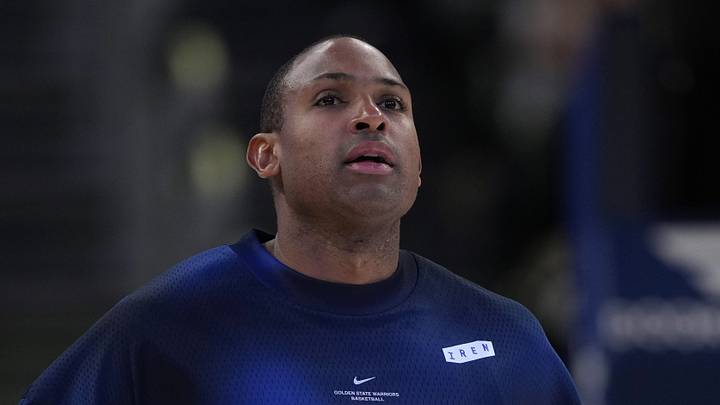
The Golden State Warriors, needless to say, need everything they can squeeze out of this rotation offensively with Stephen Curry out of the fold.
Even with their win over the Boston Celtics on Sunday, things don't look good on that front. They're dead last in the NBA in average points scored and total 3-point percentage since Curry went down on Nov. 11.
Now, a large part of that comes down to the performance of Yaxel Lendeborg and Brandin Podziemski. Neither player has been able to step up in the absence of Curry to provide a primary scoring outlet for Golden State.
But what's truly concerning has been the way in which the role players, who stepped up and performed well during the eight-game winning streak, have faded away over this last stretch. Even when Curry returns, the Warriors are going to need their depth operating at full capacity if they're going to survive this regular season with their chances at any sort of a playoff run intact.
For a number of the players on this roster, that comes down to their ability to perform consistently on both ends of the court. For Al Horford—whom the Warriors gave an above-market value (plus a player option) to this offseason—it simply comes down to his ability to convert consistently from beyond the arc.
Al Horford's primary value for the Warriors rests beyond the 3-point line at this point in his career
The reasons why the Warriors brought Horford back this offseason are relatively clear. With Quinten Post getting snatched up by the Memphis Grizzlies in restricted free agency this offseason, the Warriors simply couldn't afford to play the open market for another big man. They were forced to bring back both Horford and Kristaps Porzingis in order to fill that need, with hopes that Charles Bassey would be able to take on some rotational minutes as well.
But the contract that Horford got exceeded expectations, at least relative to his production last season. Horford played in just 45 games in 2025-26, averaging 8.4 points, 4.9 rebounds, and 2.6 assists while converting just 36.1% from beyond the arc. Roughly $7 million annually isn't a bank-breaking number, but if there was any further regression from Horford this season, both that figure and his player option could've easily come back to bite the Warriors.
It's still early in the campaign—but it looks like age has finally caught up with Uncle Al.
He has played in 14 of the Warriors' 17 games to this point in the season, which he deserves credit for given how injury-prone the rest of this rotation is. But he's averaged just 4.1 points while converting 28.6% of his 3-point opportunities in that span. For a Warriors bench unit that desperately needs offensive production and floor-spacing, that's simply not good enough.
Now, at age 40, Horford can't be expected to take on consistent minutes a starter, and it's not reasonable to expect him to provide any sort of ultra-consistent defensive impact, either. The Warriors' contract offer, last season, was a reward for him waiting out their holding period in free agency as they sorted out the Jonathan Kuminga saga. This offseason, it was a reward for staying with the team through the uncertainty that this late era of Curry's career entails.
But Horford's primary value to the Warriors, at this point in his career, needs to come from beyond the arc. His ability to consistently hit his 3-point shots needs to open up opportunities for players like Gui Santos and Will Richard on the interior—and if he's going to justify his contract number, either this season or next, that 28.6% mark from 3-point range simply can't hold.
 Add us as a preferred source on Google