

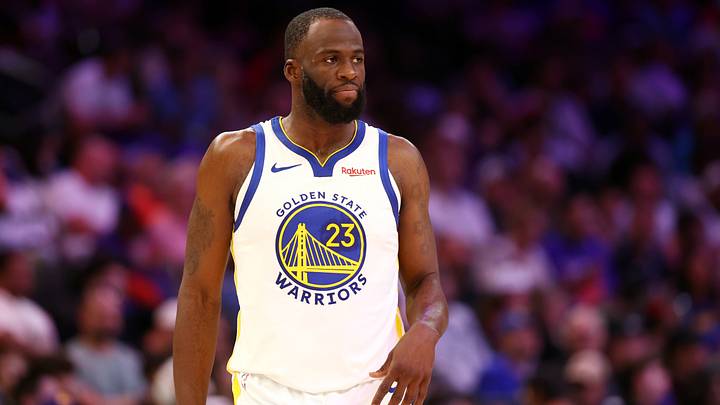
It is no secret that the Golden State Warriors are — and have been for a couple of seasons now — transitioning from the core that carried them to four NBA championships toward what appears to be an uncertain future. Steve Kerr, who signed a two-year extension this summer, knows that as well.
The organization only has a handful of players on guaranteed contracts for 2027-2028, so a big shake-up is set take place as soon as next year's trade deadline. From an on-court perspective, young players are anticipated to assume a larger role. Gui Santos proved during the second half of last season that he is capable of handling the ball and creating both for his teammates and himself. Kerr and his coaching staff are also high on Yaxel Lendeborg and believe he can impact winning in his first season at the professional level.
So where does Draymond Green, who signed a one-year, $27 million deal this offseason, fit during that "transition" year?
Steve Kerr will need Draymond Green in a different role
For years now, the Warriors have repeatedly shot themselves in the foot by committing too many turnovers. Last season, their 15.7 turnovers per game ranked as the third-highest mark in the NBA. Since their title run in 2022, only two teams — the Utah Jazz and Portland Trail Blazers — have committed more turnovers than the Warriors.
At the center of it all is Green, one of the engines of that offense. Next season, his role is expected to change. His coach wants him to shoot more threes. Kerr said on the Tom Tolbert show that he and Green had already discussed some of the adjustments the coaching staff wants to make on offense, and that some of them might generate frustration from Draymond. While Kerr didn't actually list the changes he intends to implement, it was easy to understand that the offense will depend less on the 14-year veteran.
It doesn't mean Green will be stuck in the corner all game, but his usage will probably drop. That's why Kerr wants him to shoot the three more. Not only because he's capable of burying those shots, but also because it creates chances for the rest of the lineup. It makes the defense react. It produces opportunities to crash the glass and extend possessions. Since Green was drafted in 2012, the Warriors boast a 158-58 record when Green hits at least two threes. When he hits at least three of them, they have gone 64-18.
It's become a common theme for teams to treat Green as a complete non-factor on the perimeter, simply camping out in the paint and giving him all the space in the world. That can't happen with players such as Santos, Lendeborg, or Kristaps Porzingis around him, all of whom are excellent cutters and finishers at the rim.
This team needs to stretch the floor to open up cutting lanes to the basket. That's why the addition of Georges Niang — a 39% career shooter from beyond the arc — is interesting. With either Green or Niang, the Warriors can deploy a five-out lineup featuring Curry, Podziemski, Lendeborg, and Porzingis. But Green will have to earn that respect from opposing teams and force them to at least consider him on the perimeter. A stretched-out defense means more passing lanes, and Draymond is a great passer.
By developing and trusting his three-point shot, Green would also do himself a favor. It would help extend his career. Nowadays, a player who knocks down 38% of his threes is hard to take off the floor. Pairing a league-average efficiency from three with Green's defensive acumen, championship experience, and locker room presence could translate into a multi-year contract next offseason. A player like PJ Tucker is a great example. His defensive grit and ability to knock down shots from the corner were the main reasons he managed to play meaningful basketball despite the physical effects of aging.
Even if Green does see his role decline, he'll still get to be a mentor for the younger guys. As much as he wants to play, Draymond wants to see the organization succeed. Santos made a big leap following Jimmy Butler's season-ending knee injury last season, and though he's expected to occupy a lesser role, he's earned the trust of his coach.
The same goes for the 11th pick in this year's draft, though he still needs to prove himself at the NBA level. Lendeborg averaged just 1.1 turnovers in 30.2 minutes per game at Michigan last season. The ball should be in his hands. Draymond's experience and knowledge of the game will be very valuable to both of them and to the future of the franchise.
This so-called transition year is shaping up to be a very interesting one for the team by the bay. Kerr believes this roster has the tools to make some noise in the crowded West, despite the unusually low expectations surrounding it.
As for the type of role Draymond will fill? Expect it to be diminished, but not nonexistent. His performance in the Play-In against the Los Angeles Clippers last season was clear evidence that he can still switch it on and be a top-tier defender. He needs to show that he can be a threat on the other end too. Otherwise, the Warriors might also transition away from their franchise icon.
 Add us as a preferred source on Google