

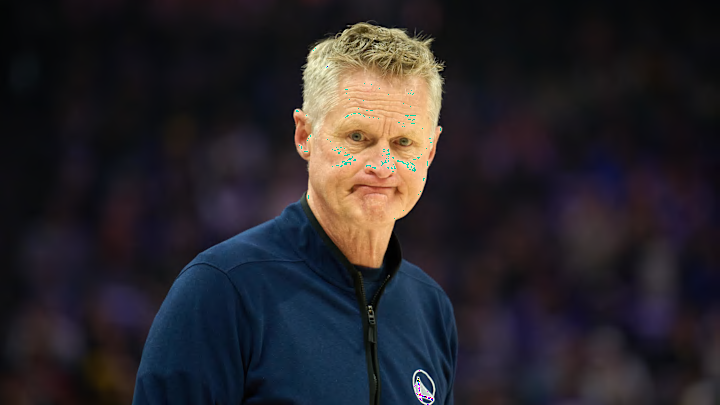
Golden State Warriors head coach Steve Kerr offered exceedingly high praise for Stephen Curry during a recent interview when he indirectly compared him to Tim Duncan. Kerr called them "culture guys who are superstars," explaining how they're uniquely capable of creating continuity.
Unfortunately, Kerr's valid and qualified praise perhaps unintentionally highlighted the primary difference between Curry and Duncan: The manner in which their successors were developed.
Kerr is uniquely qualified to comment on Curry and Duncan. He's coached Curry for 12 seasons and counting, and played four years alongside Duncan with the San Antonio Spurs. As such, few, if any, are better equipped to talk about them as culture-builders than Kerr.
That's exactly what Kerr called them in an interview with Nick Friedell of The Athletic, as he praised Curry and Duncan for helping to create continuity and championship-winning cultures.
“The beauty of Steph, the beauty of Tim Duncan, the beauty of these culture guys who are superstars, is that you can have a long run like we have, and you build continuity,” Kerr said. “And the continuity means not only do you get through the adversity, but on-court stuff makes sense. Our split cuts, we’ve been doing them for 12 years. If we had a brand new group of people, all the stuff you see Steph and Dray doing in pick-and-roll, that takes years to develop.”
Unfortunately, the Warriors failed to do for Curry what the Spurs managed to do for Duncan: Provide him with the type of support that can alleviate the burden he carries.
Spurs developed Tim Duncan's successor, but who's Stephen Curry's?
Duncan played 19 years with the San Antonio Spurs. He was the unquestioned franchise player during many of those seasons. When Father Time began to do his damage, however, the Spurs began to restructure the offense to flow through the likes of Kawhi Leonard and Tony Parker.
The end result was Parker leading the team in scoring during their championship season in 2013-14 and Leonard finishing second in MVP voting during Duncan's final season in 2015-16.
Unfortunately, the Warriors have failed to develop the type of offensive talent they've needed to take pressure off of Curry and perhaps even take on a heavier regular season burden. They briefly had talent that aided in that regard, with Jordan Poole and Andrew Wiggins excelling during the championship season in 2022.
Wiggins continued to provide value before he was traded for Jimmy Butler—a justifiable move—but Poole was ultimately moved for a then 38-year-old Chris Paul. As many expected to transpire, Paul was on a new team just one year later.
Warriors must develop talent as individuals, not just parts of a system
Golden State has drafted talent players, including Jonathan Kuminga, Moses Moody, and Brandin Podziemski. While the Spurs built a system within which other players developed alongside Duncan, however, the Warriors have molded their talent into supporting pieces who complement Curry.
Though that isn't necessarily a bad thing, the limitations placed upon them created a rigid system in which growth beyond how they directly complement Curry was stifled.
Compounded by poor decisions such as tossing aside Ryan Rollins—who averaged 17.3 points and 5.6 assists per game in 2025-26—in the trade for Paul, the Warriors have missed the mark. There's certainly still time to give Curry another run at a title, but they're playing an unnecessary game of catch-up while racing the clock with a 38-year-old franchise player.
Kerr's praise for Curry was undoubtedly positive, but whether or not he intended to, he highlighted a key difference between the Warriors' retooling and the Spurs' success in building with and beyond Duncan.
 Add us as a preferred source on Google