

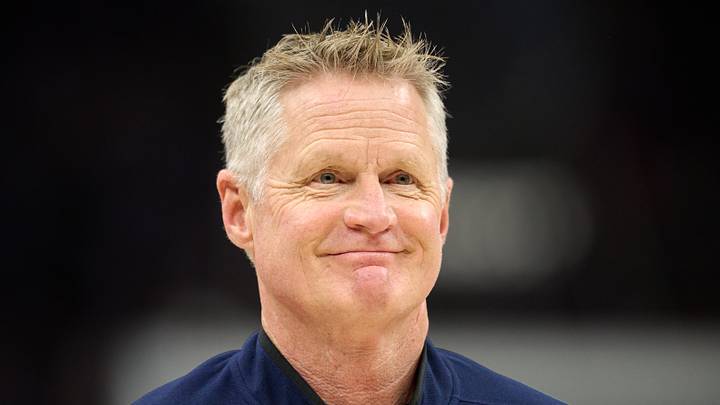
The Golden State Warriors officially extended their winning streak to eight games with a blowout victory over the New Orleans Pelicans last night.
Now, they haven't beaten any of the league's premier teams so far. But who expected them to be playing this well after the way the first three games of the season went? They've found a way to make both this small-ball starting lineup and the depth of the rotation work together on a game-to-game basis, and even moreso than the winning record, that's a highly promising development.
Golden State can't afford to simply tread water until Jimmy Butler and Moses Moody return—that would leave them with too big a hole to dig out of by the time the rotation truly returned to full strength. Each of these wins is significant in that context
But even more importantly, the Warriors needed to find different combinations and different looks they could go to over the course of the season. And as each player begins to settle into their respective role, that's become their silent weapon across these first 11 games.
The Warriors' rotation is much more versatile than anyone expected in 2026-27
Of course, the pillars of this team are always going to be Stephen Curry and Draymond Green—the pair has found a new rhythm with Green taking on more of a playmaking role, and their two-man game looks about as efficient as it ever has.
The goal for Steve Kerr, and for the team as a whole, was to figure out what else they had around those players through the first couple months of the season.
The biggest development has, obviously, been Yaxel Lendeborg. Even beyond coming out of the gates as an immediately viable scorer in his rookie year, he's also been used as the primary ball-handler when Curry's been off the court. For a team that desperately needs to win those minutes as often as it can, that's a significant step in Lendeborg's game.
It also opens up rotational options for Kerr to employ, and games like the one against New Orleans provide perfect opportunities for that. Slotting in Al Horford for backup center minutes with Lendeborg on the court gives the team some additional floor-spacing (augmented by De'Anthony Melton's recently reclaimed perimeter shooting). That's also been a defensively viable lineup. Across the 109 minutes Horford and Lendeborg have shared the court, Golden State has a solid defensive rating of 108.9 per Databallr.
Charles Bassey has also provided predictably energetic play, and Kerr went to him off the bench towards the end of the first quarter yesterday to provide some rebounding juice. His developing chemistry with Lendeborg on the pick-and-roll also provides the Warriors with an additional weapon to utilize against teams without a physical big man.
The Brandon Williams and Will Richard injuries will certainly hurt the outlook for the backcourt off the bench, but having Cryer on a two-way contract, given his 3-point shooting ability, is an underrated luxury for this team.
There's also ample room to play with the rotations of Melton and Brandin Podziemski, and Gui Santos could certainly see some minutes as a holdover with the bench unit once he gets going as an interior scorer this season.
In short, the Warriors have not just found one look that works—they've found multiple just 11 games into the season. Beyond the concrete form of the starting lineup, there are Podziemski/Melton combinations that can be found, a Santos/Niang/Horford lineup to maximize floor spacing, or even starting opportunities for Bassey when the matchup necessitates it. When at full strength, Golden State can also lean into Williams' speed to try to burn teams in transition with their bench unit, utilizing a smaller lineup in that context.
In short, Golden State was a team that didn't have many options this offseason. All of their external signings were essentially the scraps of free agency. And yet they've been able to identify options for Kerr this early in the season, and as the campaign wears on, that's what the lasting impact of this win streak will ultimately be.
 Add us as a preferred source on Google